Short Answer: Filter Particles, Exchange Air for CO₂
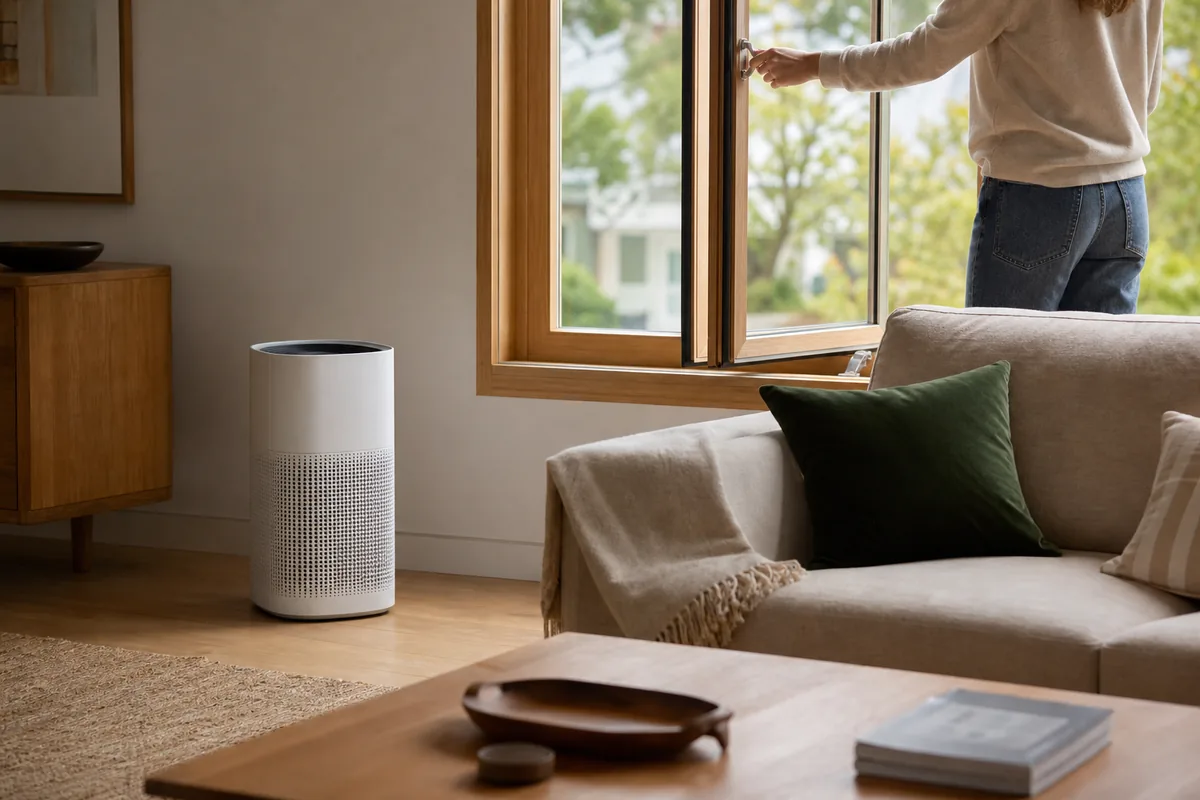
An ordinary portable air purifier will not lower carbon dioxide in a room. A purifier with a high-efficiency particle filter, often called HEPA, pulls room air through the filter and returns that same air. It can reduce PM2.5—the fine particles in cooking smoke, dust, and wildfire smoke—but the people in the room keep breathing out CO₂. To lower that reading, the practical household fix is to replace stale indoor air with cleaner outdoor air through an open window, a fresh-air intake, or a properly designed heat-recovery ventilator (HRV) or energy-recovery ventilator (ERV).
Home Assistant should therefore run two different responses. When CO₂ rises, turn on a real outdoor-air ventilation mode or send a reminder to open a window. When PM2.5 rises, remove the source and run filtration. Before opening a window, check whether outdoor air is actually cleaner; wildfire smoke can make the obvious CO₂ fix the wrong PM2.5 decision.
Home Assistant 2026.7 makes this easier with plain-language air-quality triggers and conditions. Still, the automation needs a stable reading, separate start and stop points, and a manual fallback. The number is evidence for a decision—not permission to wire a heating, ventilation, and air-conditioning (HVAC) system unsafely or treat a consumer monitor as a life-safety alarm.
The one-line rule: ventilation dilutes CO₂; filtration captures particles. A good air-quality automation knows which problem it is solving before it turns anything on.
Match Each Reading to the Right Response
| Reading | What it means in the house | Useful Home Assistant response | What not to assume | Main caveat |
|---|---|---|---|---|
| CO₂ parts per million, or ppm |
Usually a clue that people are occupying a room faster than outdoor air is replacing their exhaled air. | Enable a manufacturer-supported fresh-air or boost mode, or notify someone to open a window when outdoor air, weather, and security conditions are suitable. | A HEPA purifier, ceiling fan, or HVAC blower in recirculation mode does not add outdoor air. | CDC and ASHRAE say one ppm target does not fit every room. Sensor location, calibration, occupancy, and room use matter. |
| PM2.5 fine particles |
Often comes from cooking, candles, smoke, cleaning, outdoor pollution, or wildfire smoke entering the home. | Stop the source when possible and run a correctly sized particle filter or air purifier. Close windows when outdoor PM2.5 is worse. | Opening a window is not always cleaner. An outdoor smoke event can raise indoor particle exposure. | Choose a threshold from local public-health guidance and the sensor's instructions; a brief cooking spike is different from an all-day smoke event. |
| VOCs volatile organic compounds |
A broad group of gases from products, finishes, cleaners, fragrances, cooking, and other sources. | Remove or reduce the source first. Ventilate when outdoor air is suitable; use gas-phase filtration only when the product documents the target gas and capacity. | A particle filter does not automatically remove gases, and a small carbon sheet does not remove every VOC indefinitely. | Consumer VOC readings are often best used as trends. Follow the exact monitor and filter documentation before automating a strong response. |
| CO or smoke alarm | A possible life-safety event, not an ordinary comfort or ventilation reading. | Let certified alarms sound and follow their emergency instructions. Home Assistant may send a secondary alert or turn on lights to help people leave safely. | A CO₂ monitor does not detect carbon monoxide, and a dashboard is not a certified alarm panel. | Do not make internet, Home Assistant, or a smart speaker the only warning path. |
Validate the Sensor Before It Controls the House
A believable number is not automatically a trustworthy control signal. CDC says calibration, placement, and maintenance all matter, and ASHRAE says sensor performance and location are critical when drawing conclusions from indoor CO₂.
- Follow the warm-up instructions. Do not automate from the first number after unboxing or power loss. IKEA says ALPSTUGA can take up to 12 hours after connection to produce an accurate CO₂ reading.
- Place it where the room is actually occupied. Keep it away from a person's direct breath, an open window, a supply register, a purifier outlet, steam, and cooking splatter. A monitor in a draft can describe the draft instead of the room.
- Watch the pattern before choosing a threshold. Compare an empty room, normal occupancy, a closed-door night, and a known ventilation period. A repeatable rise and fall is more useful than one dramatic screenshot.
- Check the product's measurement method. Some inexpensive devices estimate “equivalent CO₂” from another gas sensor instead of measuring CO₂ directly. The product documentation should say what it measures.
- Investigate implausible readings. Do not hide a sensor problem by widening thresholds. Follow the maker's calibration procedure, check the device's internal software (firmware) and power, and compare with a known-good instrument when the decision is important.
A March 2026 r/homeassistant post about unusually high ALPSTUGA readings received about 90 votes and many calibration suggestions. That is useful evidence that owners are seeing the problem; it is not a substitute for IKEA's manual or an instrument comparison.
Build the Automation in Home Assistant 2026.7
Start in Settings > Automations & scenes. Home Assistant 2026.7 made purpose-specific triggers the default, so supported devices and areas can offer choices such as Carbon dioxide level crossed threshold directly. If the connection method for your sensor offers only a number, use the visual editor's standard number-above-or-below trigger with the same start and stop values and delays.
Rule 1: Start Ventilation When CO₂ Stays High
- Choose the bedroom, office, or the specific CO₂ sensor as the target.
- Add Carbon dioxide level crossed threshold. Home Assistant's own example uses 1,000 ppm. Treat that as a practical starting point, not a universal danger line.
- Set For at least to five or ten minutes so one breath, sensor update, or passing person does not start the system.
- Add the Carbon dioxide value condition at the same threshold. The crossed-threshold trigger fires when the reading crosses in either direction, so this condition confirms it is currently on the high side.
- Turn on a real fresh-air mode that the equipment maker supports. If the home has no controlled outdoor-air system, send a clear notification such as “Office CO₂ has stayed high; open the window if outdoor air and weather are good.”
Rule 2: Stop at a Lower Number
Create a second rule with a lower stop point—Home Assistant's example uses 800 ppm. Trigger when that lower threshold is crossed, then add a condition confirming the current reading is below it. This gap between the start and stop points is called hysteresis. In the house, it simply means the fan does not chatter on and off every time the sensor moves by a few ppm.
Add a reasonable minimum run time if the equipment supports one, and keep its normal wall control available. If the reading becomes unknown or unavailable, stop making new automatic window or ventilation decisions and notify the homeowner instead.
Rule 3: Treat PM2.5 as a Filtration Decision
- Use the indoor PM2.5 reading and require a sustained increase rather than a single update.
- Check for an indoor source first: cooking, a candle, a fireplace, vacuuming, or smoke. Source control beats running a purifier against an ongoing source.
- Compare outdoor air before opening windows. Home Assistant's official AirNow integration can provide U.S. outdoor data, but it is a cloud-polling service and needs internet.
- If outdoor particles are worse, keep windows closed and run filtration. AirNow's wildfire guidance says portable cleaners work best with doors and windows closed.
- If outdoor air is cleaner and weather and security allow, ventilation may help the indoor source clear. Do not motorize an exterior window without rain, freeze, intrusion, child, and manual-override safeguards.
Home Assistant's air-quality documentation uses 25 micrograms per cubic meter (µg/m³) as one wildfire purifier example. It is an example automation value, not a universal medical boundary. Use local guidance, the device manual, household needs, and the sensor's real behavior.
What Works Locally, and What Still Needs Cloud?
The automation can be fully local when the sensor, Home Assistant, and the controlled equipment all communicate inside the house. A Matter-over-Thread sensor such as IKEA ALPSTUGA can report through Home Assistant's local Matter controller once it is added, and a genuinely local fan, relay, or ventilation connection can respond without an internet round trip.
That does not make every purifier or data source local. Some purifier integrations require a vendor account and app. Home Assistant's VeSync documentation, for example, lists current Levoit Core models but requires devices to be added in the VeSync app first. AirNow is explicitly Cloud Polling. If either service is unavailable, Home Assistant should show the data as unavailable instead of reusing an old “outdoor air is clean” value to open a window.
For a no-cloud design, check the integration's IoT class—Home Assistant's documentation label for local or cloud behavior—and test the exact automation during an internet outage. Keep a physical button or manufacturer control for the purifier or ventilator. Local control is a property of the whole path, not the word Matter, Zigbee, Wi-Fi, or smart on one box.
Safety Boundaries That Belong in the Automation
- Do not use a random smart plug for fixed HVAC, HRV, or ERV equipment. Use the maker's supported control input or an installer-approved integration. Motor loads, required shutdown behavior, and equipment warranties matter.
- Do not assume an ordinary furnace blower ventilates. Many systems only recirculate indoor air unless a documented outdoor-air intake or ventilator is operating.
- Be careful with large exhaust fans. EPA warns that strong exhaust without enough replacement outdoor air, often called make-up air, can lower the home's air pressure and pull combustion gases back down a flue. Ask an HVAC professional when the home has a natural-draft furnace, water heater, fireplace, or other fuel-burning equipment.
- Never let outdoor data fail open. If AirNow, weather, or an outdoor sensor is unavailable, do not automatically open a window. Notify and wait for a person.
- Keep certified alarms independent. Smoke and carbon-monoxide alarms must work without Home Assistant, Wi-Fi, cloud services, or a phone.
Air-quality automation is useful for comfort, awareness, and operating existing equipment more intelligently. It is not a diagnosis, a code-compliance test, or a replacement for professional ventilation design.
Tara's Recommendation
Build two simple loops, not one vague “air quality” rule. Use CO₂ to request clean outdoor-air exchange, and use PM2.5 to request source control plus filtration. Give both a delay, a separate stop point, a manual override, and an unavailable-data path.
For a local-first home, keep the indoor sensor and equipment control local. Use an outdoor service only as an extra safety gate, and fail safely when it disappears. Document which fan actually brings in outdoor air, which one only recirculates, and what the household should do when a notification appears.
Tara's role is to package those details into a tested handoff: sensors in sensible places, one automation owner, safe equipment controls, outdoor-air checks, and physical fallbacks that still make sense to the next person in the house.
Frequently Asked Questions
Will an air purifier lower carbon dioxide?
No ordinary portable purifier with a high-efficiency particle filter will. It filters particles while recirculating room air. Lower CO₂ with clean outdoor-air exchange through a window, fresh-air intake, heat-recovery ventilator, energy-recovery ventilator, or another properly designed ventilation path.
What should Home Assistant turn on when CO₂ is high?
Use an existing manufacturer-supported fresh-air or ventilation boost mode. If the house has no controllable outdoor-air system, send a reminder to open a window when outdoor air, weather, and security conditions are suitable.
What should Home Assistant do when PM2.5 is high?
Remove the indoor source when possible and run a properly sized particle filter or purifier. If outdoor smoke or PM2.5 is worse, keep windows closed. If outdoor air is clean, ventilation may also help.
Is 1,000 ppm CO₂ a universal danger limit?
No. Home Assistant uses 1,000 ppm as a practical automation example, while CDC and ASHRAE warn that one concentration does not fit every room and occupancy. Use it as a starting point, not a medical or safety guarantee.
Can this automation work without internet?
Yes, when the sensor, Home Assistant, and equipment control are all local. AirNow and some vendor purifier integrations need cloud access, so build a safe unavailable-data fallback and test the exact path with the internet disconnected.
Can a CO₂ monitor replace a carbon-monoxide alarm?
No. CO₂ and carbon monoxide are different gases. Keep certified smoke and carbon-monoxide alarms, follow their emergency instructions, and use Home Assistant only for secondary notifications.